Specs and Reviews
Version 0.5.0 · 8 pages · PDF · Word
How does work get from an idea to done?
Section titled “How does work get from an idea to done?”When several people share the work on one thing, they need to agree on what they’re making, who is doing which part and when each part is finished. If your experience of a team is one person doing most of the heavy lifting, you may not have needed much of this. Once the work is shared, a spec, work items, a tracker, acceptance criteria and reviews keep everyone on the same page.
You define the result in a spec, split it into work items, and keep them in a tracker. Before work starts, you agree on acceptance criteria, so the person doing it and the reviewer use the same test.
| Term | Meaning |
|---|---|
| Spec | What you want built and why. |
| Work item | One piece of work one person can finish. |
| Tracker | The shared list of work, owners and statuses. |
| Acceptance criteria | Conditions the finished work must meet. |
| Review | Someone else checks, then approves or requests changes. |
How do the parts fit together?
Section titled “How do the parts fit together?”Every step updates the tracker, so anyone can see who has each item and where it stands. Requested changes send the item back to in progress.
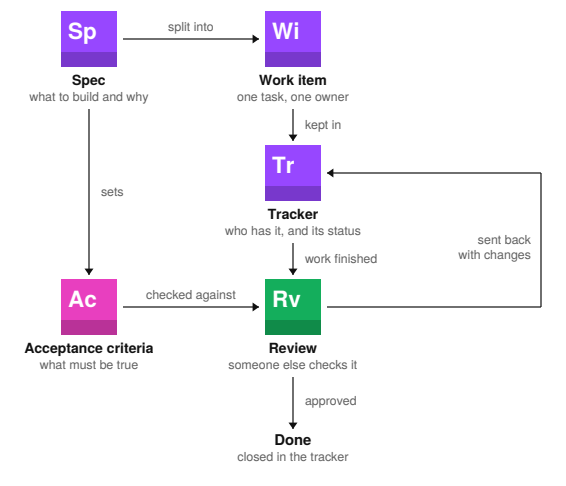
01 Spec
Section titled “01 Spec”| Field | Text |
|---|---|
| Identify by | Requirements, a design or a brief in a shared document. |
| What | A spec says what you want built and why. The spec also says what the work covers and leaves out. |
| So what | A shared spec keeps everyone working toward the same result. The people asking and those doing the work agree before it is split up. |
Field marks
Section titled “Field marks”| Field | Short answer |
|---|---|
| Owned by | The person asking for the work |
| Kept in | A shared document |
| Cannot | Cover what nobody wrote down |
Confused with: Work item
Section titled “Confused with: Work item”A spec describes the whole result and why it’s wanted. A work item is one piece of that work, sized for one person.
02 Work item
Section titled “02 Work item”| Field | Text |
|---|---|
| Identify by | A task, ticket, issue or story in a tracker. |
| What | A work item is one piece of a larger job, small enough for one person to finish in days. The item links to the spec and holds its acceptance criteria. |
| So what | Small work items show progress and problems early. Problems get fixed while they’re still small. |
Field marks
Section titled “Field marks”| Field | Short answer |
|---|---|
| Owned by | One person |
| Kept in | The tracker |
| Cannot | Replace a missing spec |
Confused with: Milestone
Section titled “Confused with: Milestone”A milestone is a date or release for finishing several items, not work itself.
03 Tracker
Section titled “03 Tracker”| Field | Text |
|---|---|
| Identify by | A shared tool such as GitHub Issues, Jira or a spreadsheet. |
| What | A tracker is the shared list of work items. Each item has an owner and a status. |
| So what | A current tracker makes progress visible. Anyone can see who has what, what is stuck and what is done. |
Field marks
Section titled “Field marks”| Field | Short answer |
|---|---|
| Owned by | Everyone using it |
| Kept in | One shared tool |
| Cannot | Judge the result |
Confused with: Backlog
Section titled “Confused with: Backlog”A backlog holds unstarted work. A tracker also holds work in progress, review or done.
04 Acceptance criteria
Section titled “04 Acceptance criteria”| Field | Text |
|---|---|
| Identify by | Short statements in the work item, each one true or false. |
| What | Acceptance criteria state what must be true for a work item to be accepted. For example, a user can reset a password from the sign-in page. |
| So what | Agreed criteria give the person doing the work and the reviewer the same test. Set them before work starts. |
Field marks
Section titled “Field marks”| Field | Short answer |
|---|---|
| Owned by | The person asking for the work |
| Kept in | The work item |
| Cannot | Catch an unwritten case |
Confused with: Definition of done
Section titled “Confused with: Definition of done”Acceptance criteria apply to one item. A definition of done is a checklist for every item.
05 Review
Section titled “05 Review”| Field | Text |
|---|---|
| Identify by | A code review, design review or sign-off in the work item. |
| What | A review checks work against its acceptance criteria. The reviewer, who didn’t do the work, approves it or asks for specific changes. |
| So what | A second person catches a missed condition or mistake. Mistakes are hard to see in your own work. |
Field marks
Section titled “Field marks”| Field | Short answer |
|---|---|
| Owned by | The reviewer |
| Kept in | The work item |
| Cannot | Find every problem |
Confused with: Approval
Section titled “Confused with: Approval”A review is the check, and approval is the decision it can end in. If someone approves work without checking it, there was no review.
One work item, start to finish
Section titled “One work item, start to finish”The work item keeps its owner, status, criteria and review together in the tracker.
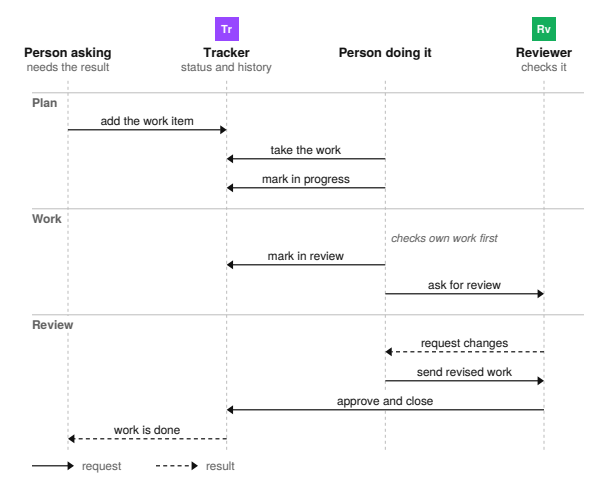
Approval closes the item. A request for changes sends it back to in progress with the reviewer’s comments, then back to review.
Easy to mix up
Section titled “Easy to mix up”| Question | Answer |
|---|---|
| Spec or acceptance criteria? | The spec covers the whole result. Acceptance criteria say what one finished item must meet. |
| Review or testing? | Testing checks behavior. Review lets another person judge the result and the evidence. |
| Done or released? | Done means the item was accepted. Released means its result has reached its users. |
Sources
Section titled “Sources”These public sources were checked in October 2026.
| Source | Date | Address |
|---|---|---|
| Ken Schwaber and Jeff Sutherland, The Scrum Guide | November 2020 | scrumguides.org/scrum-guide.html |
| Agile Alliance, Agile Glossary | October 2026 | agilealliance.org/agile101/agile-glossary/ |
| GitHub Docs, Issues | October 2026 | docs.github.com/en/issues |
| Google, Engineering Practices: Code Review | October 2026 | google.github.io/eng-practices/review/ |
A person writes and reviews every guide. AI does the grunt work.