Loading a Dishwasher
Draft · Version 0.6.0 · 7 pages · PDF · Word
Is there a right way to load a dishwasher?
Section titled “Is there a right way to load a dishwasher?”There is a right way to load a dishwasher, and the people who make them mostly agree on it, which is more than can be said for some kitchens. Water sprays up from an arm under each rack, so a dish comes clean when its dirty side faces the spray and nothing blocks the way.
The makers disagree on a few details, such as cutlery and glasses. When they do, your own dishwasher’s manual wins.
| Term | Meaning |
|---|---|
| Bottom rack | The lower rack, for plates, pots, pans and big items. |
| Top rack | The upper rack, for cups, glasses, small bowls and plastics. |
| Cutlery basket | The basket that holds knives, forks and spoons upright. |
| Spray arm | The turning arm under a rack that sprays water up. |
| Detergent | What goes in the dispenser and breaks down food. |
Where does everything go?
Section titled “Where does everything go?”Put each item where water can reach its dirty side and drain away. Before you start, check that nothing blocks the detergent dispenser or stops a spray arm turning.
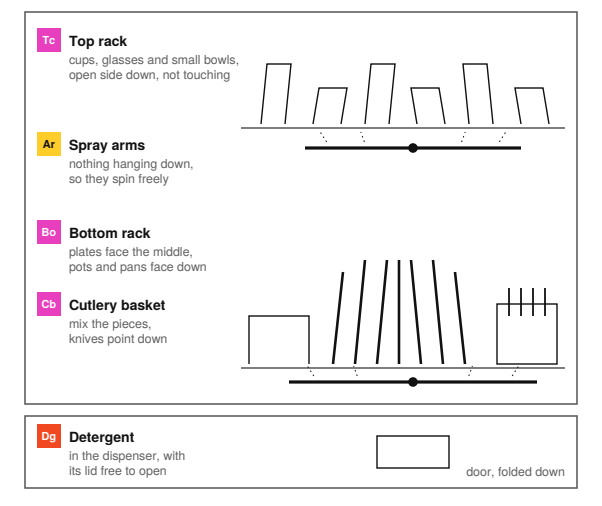
01 Bottom rack
Section titled “01 Bottom rack”| Field | Text |
|---|---|
| Identify by | The lower of the two main racks. |
| What | The bottom rack holds plates, pots, pans and other large items. Stand plates on their sides between the tines, facing the middle, and put pots and pans open side down. |
| So what | The bottom rack gets the strongest spray, so the dirtiest things go here. Keep platters clear of the spray arm. |
Field marks
Section titled “Field marks”| Field | Short answer |
|---|---|
| Job | Hold big, dirty items |
| Watch for | Blocking the dispenser |
| Cannot | Clean stacked dishes |
Confused with: Top rack
Section titled “Confused with: Top rack”The bottom rack gets the strongest spray, for heavy and dirty things. The top rack is for small, light and delicate ones.
02 Top rack
Section titled “02 Top rack”| Field | Text |
|---|---|
| Identify by | The upper rack, for smaller items. |
| What | The top rack holds cups, glasses, small bowls and plastics. Put them open side down, angled and apart. |
| So what | The top rack usually runs cooler, which keeps plastic from melting. Makers differ on glasses in the bottom rack. |
Field marks
Section titled “Field marks”| Field | Short answer |
|---|---|
| Job | Hold small, light items |
| Watch for | Glasses touching |
| Cannot | Save unsafe plastic |
Confused with: Third rack
Section titled “Confused with: Third rack”A third rack, on machines that have one, is a cutlery tray. Miele says to group the pieces in it by kind.
03 Cutlery basket
Section titled “03 Cutlery basket”| Field | Text |
|---|---|
| Identify by | A basket with sections, in the bottom rack. |
| What | The cutlery basket holds knives, forks and spoons upright. Mix the pieces so they don’t nest, and most makers say knives point down. |
| So what | Makers split on forks and spoons. Miele says handles up is safer for knives and forks, and handles down cleans better. |
Field marks
Section titled “Field marks”| Field | Short answer |
|---|---|
| Job | Hold cutlery upright |
| Watch for | Spoons nesting |
| Cannot | End the argument |
Confused with: Silverware basket
Section titled “Confused with: Silverware basket”A silverware basket is the same thing. Many US manuals use that name, so look for either in yours.
04 Spray arm
Section titled “04 Spray arm”| Field | Text |
|---|---|
| Identify by | The turning arm under each rack. |
| What | The spray arm turns under a rack and sprays wash water up through it. Each arm needs room to turn. |
| So what | A pan handle or utensil hanging through a rack can stop an arm. Turn each spray arm by hand before you start, to check that it spins. |
Field marks
Section titled “Field marks”| Field | Short answer |
|---|---|
| Job | Spray water at dishes |
| Watch for | Tall or hanging items |
| Cannot | Reach blocked surfaces |
Confused with: Filter
Section titled “Confused with: Filter”The spray arm moves water around the dishwasher. The filter catches food from that water and needs cleaning regularly.
05 Detergent
Section titled “05 Detergent”| Field | Text |
|---|---|
| Identify by | A pod, tablet, powder or gel in the door dispenser. |
| What | Most dishwasher detergents use enzymes to break down starch and protein. One tablet or pod is enough. |
| So what | Put it in the dispenser and close the lid. Never use hand dish soap, which foams too much. |
Field marks
Section titled “Field marks”| Field | Short answer |
|---|---|
| Job | Break down food |
| Watch for | Hand dish soap |
| Cannot | Escape a blocked lid |
Confused with: Rinse aid
Section titled “Confused with: Rinse aid”Detergent removes food during washing. Rinse aid helps water drain off, which improves drying and reduces spots.
The usual arguments
Section titled “The usual arguments”| Question | Answer |
|---|---|
| Rinse first? | No. Scrape off food and skip the tap. If dishes will sit overnight, run the dishwasher’s rinse cycle instead. |
| Knives, forks and spoons up or down? | Most makers say knives point down. Mix the rest so nothing nests. Makers split on forks and spoons. |
| Pod in the dispenser or loose in the tub? | In the dispenser, with the lid closed. |
| Run it only when full? | When you can, since a dishwasher uses about the same water and energy either way. Leave room for the water to reach everything. |
| Run the hot tap first? | Whirlpool says yes, because cool water can mean a poor wash. Run the nearest hot tap until the water is hot. |
When advice differs, your dishwasher’s manual wins.
Sources
Section titled “Sources”These public sources were checked in October 2026.
A person writes and reviews every guide. AI does the grunt work.