The First Move in Chess
Draft · Version 0.4.0 · 10 pages · PDF · Word
What should your first move be?
Section titled “What should your first move be?”White moves first, then the players take turns. Start with a pawn in the middle of the board, bring out your knights and bishops, then castle to put your king somewhere safer. You don’t need to memorize a string of moves.
The first few moves have two jobs: get your pieces into the game quickly and get your king safe. When you’re learning, a few principles help more than memorized sequences of moves, because they work against whatever the other player does.
Center, development and castling cover most of what you need at the start.
| Term | Meaning |
|---|---|
| Center | The four squares in the middle of the board. |
| Development | Moving knights and bishops out so they can take part. |
| Castling | One move of your king and a rook together. |
How do you read the board?
Section titled “How do you read the board?”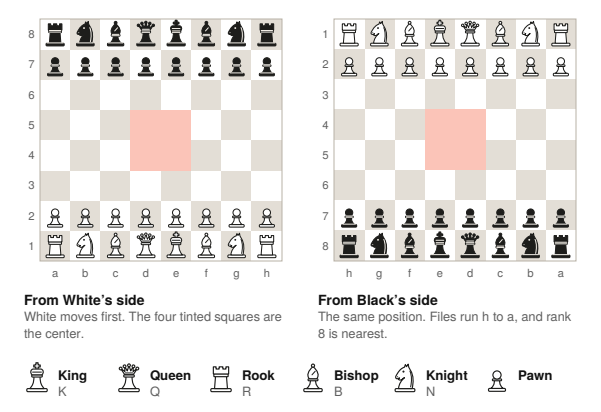
Each square has a letter and a number. From White’s side, the columns, called files, run from a to h, left to right. The rows, called ranks, run from 1 to 8, going away from White. Set it down so each player has a light square in the near right corner.
Pieces use K for king, Q for queen, R for rook, B for bishop and N for knight. A pawn move is written as the square it lands on. Moves are numbered with White first, so 1.e4 e5 means White’s pawn goes to e4, then Black’s pawn goes to e5. Black’s move alone is 1…e5. An x means a capture, and # means checkmate.
01 Center
Section titled “01 Center”| Field | Text |
|---|---|
| Identify by | The four middle squares, d4, d5, e4 and e5. |
| What | The center is the four squares in the middle of the board. Start by moving the pawn in front of your king or queen two squares into it. |
| So what | A center pawn move frees your queen and a bishop to move. The center usually opens first, because center pawns often capture each other. |
Field marks
Section titled “Field marks”| Field | Short answer |
|---|---|
| When | On your first move |
| Aim | A pawn in the middle |
| Mistake | Too many pawn moves |
Confused with: Pawn moves
Section titled “Confused with: Pawn moves”One or two center pawn moves help your pieces get out. Too many early pawn moves leave your knights and bishops at home.
02 Development
Section titled “02 Development”| Field | Text |
|---|---|
| Identify by | Knights and bishops leaving their starting squares. |
| What | Development is moving your knights and bishops out so they can take part. Try to move each piece once before moving it again. |
| So what | A lead in development gives you more pieces in the game than your opponent. Your opponent is trying to bring pieces out too. |
Field marks
Section titled “Field marks”| Field | Short answer |
|---|---|
| When | After a center pawn |
| Aim | Knights and bishops out |
| Mistake | Moving one piece twice |
Confused with: Bringing out the queen
Section titled “Confused with: Bringing out the queen”Bring your queen out after your knights and bishops. An early queen can be chased by knights and bishops that your opponent wanted to develop anyway.
03 Castling
Section titled “03 Castling”| Field | Text |
|---|---|
| Identify by | The king moves two squares and a rook moves past it. |
| What | Castling is one move of the king and a rook, written 0-0 on the king’s side or 0-0-0 on the queen’s side. The king moves two squares toward the rook, then the rook lands on the square the king crossed. |
| So what | Castling moves your king away from the center and brings a rook toward it. Castle early, after moving the pieces between your king and rook. |
Field marks
Section titled “Field marks”| Field | Short answer |
|---|---|
| When | Early in the game |
| Aim | A safer king |
| Mistake | Waiting too long |
Confused with: Moving the king
Section titled “Confused with: Moving the king”An ordinary king move goes one square. To castle, neither the king nor that rook may have moved, and no piece can stand between them. The king can’t castle out of check, and it can’t cross or land on a square an enemy piece attacks. Move the king first, then the rook.
What do you play, as White or Black?
Section titled “What do you play, as White or Black?”Pick the row for your color and the last move played.
| Move | Why |
|---|---|
| 1.e4 | As White. The e-pawn moves two squares and frees the queen and a bishop to move. |
| 1.d4 | As White. The same idea with the d-pawn. |
| 1…e5 | As Black, after 1.e4. The e-pawn moves two squares, blocks White’s e-pawn and frees the queen and a bishop to move. |
| 1…d5 | As Black, after 1.d4. The same idea with the d-pawn. |
| 2.Nf3 Nc6 | White’s knight goes to f3 and Black’s knight goes to c6. Bishops come next. Each move brings one piece into the game. |
| 0-0 | Castle on the king’s side once the knight and bishop between king and rook have moved. |
Then keep bringing out pieces you haven’t moved yet.
Openings for White
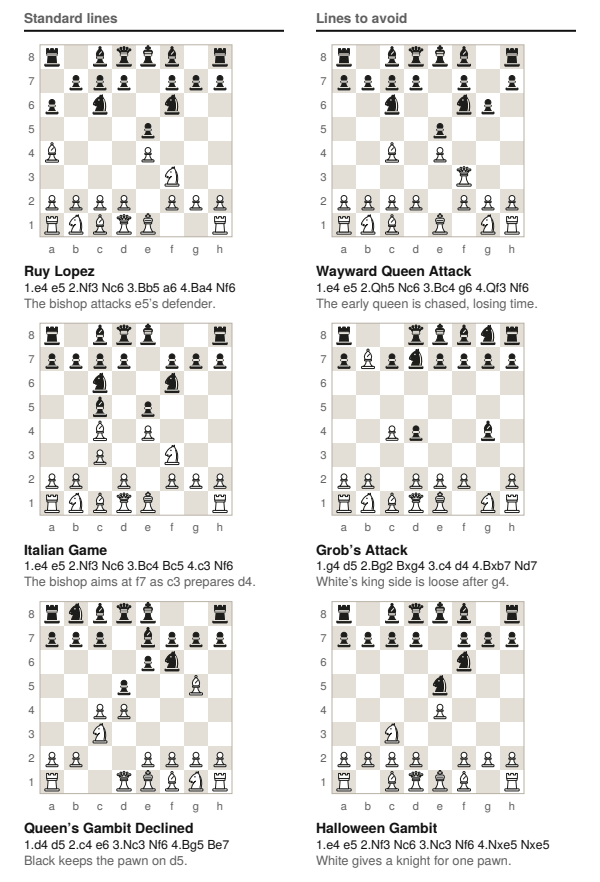
Section titled “Openings for White”Each board shows the position after both players have made four moves.
Openings for Black
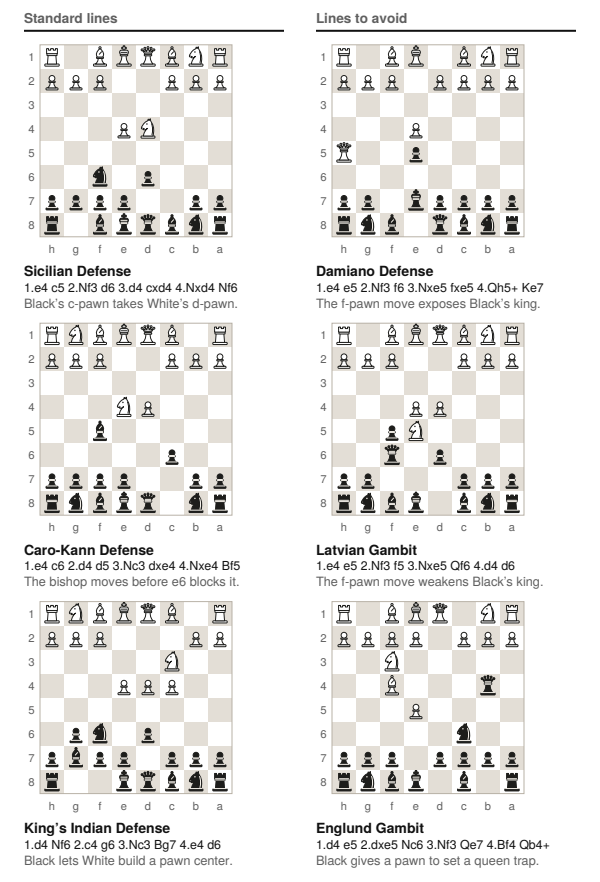
Section titled “Openings for Black”Each board shows four moves by each player, drawn from Black’s side.
Sources
Section titled “Sources”These public sources were checked on 22 October 2026.
| Source | Date | Address |
|---|---|---|
| FIDE, Laws of Chess | January 2023 | handbook.fide.com/chapter/E012023 |
| FIDE, Curriculum: Chess for Refugees | October 2023 | fide.com/docs/presentations/Curriculum%20Chess%20for%20Refugees.pdf |
| US Chess, Guide to Scholastic Chess, 11th edition | June 2021 | new.uschess.org/sites/default/files/media/documents/11th-edition-guide-to-scholastic-chess-6-29-21.pdf |
| Wikipedia, List of ECO codes and each opening’s article | October 2026 | en.wikipedia.org/wiki/List_of_ECO_codes |
| Lichess, opening explorer | October 2026 | lichess.org/opening |
A person writes and reviews every guide. AI does the grunt work.