The Caro-Kann for Black
Draft · Version 0.3.0 · 9 pages · PDF · Word
What is the Caro-Kann?
Section titled “What is the Caro-Kann?”The Caro-Kann is a chess opening for Black that begins 1.e4 c6, usually followed by 2.d4 d5. The c-pawn move prepares …d5, which challenges White’s pawn on e4. The Caro-Kann is known for being solid.
The Caro-Kann answers 1.e4 only. Against 1.d4, a simple start is 1…d5, as in An Accidental Guide to: The First Move in Chess, which also explains the notation. An x is a capture, # is checkmate and … marks a move by Black. Every board is seen from Black’s side, with the a-file on your right.
You need four terms for the plan.
| Term | Meaning |
|---|---|
| The light bishop | Black’s bishop that starts on c8 and moves on the light squares. |
| Advance | White pushes the e-pawn to e5. |
| Exchange | White swaps the e-pawn for your pawn on d5. |
| Main line | White defends e4 with a knight, you take the pawn, and the knight takes back. |
What does Black set up?
Section titled “What does Black set up?”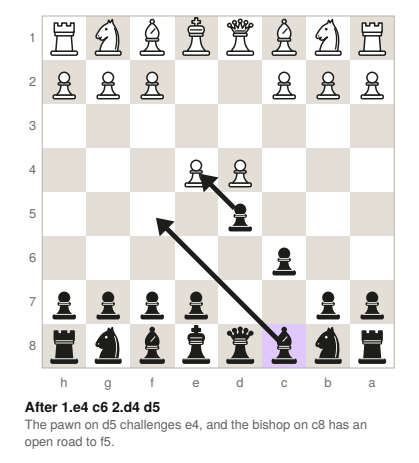
White has three main choices on move 3. White can push the e-pawn to e5 in the Advance, swap it on d5 in the Exchange, or defend it with a knight in the Main line, and you take on e4. In each line, the light bishop comes out before …e6, then you bring out your other pieces and castle.
01 The light bishop
Section titled “01 The light bishop”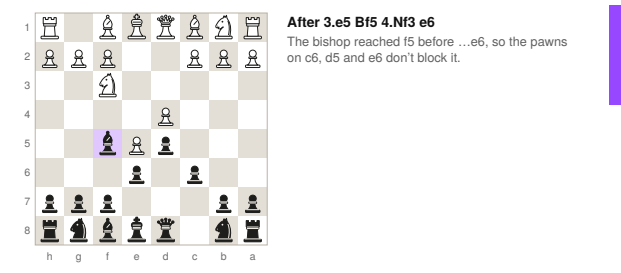
| Field | Text |
|---|---|
| Identify by | Your bishop from c8 on f5 or g4, outside the pawns on c6, d5 and e6. |
| What | The light bishop is Black’s bishop that starts on c8. Bring it to f5 or g4 before you play …e6. |
| So what | A pawn on e6 would shut the bishop in. Once the bishop is out, play …e6, bring out your knights and castle. |
Field marks
Section titled “Field marks”| Field | Short answer |
|---|---|
| White plays | Any third move |
| You play | Bishop out, then …e6 |
Confused with: The French Defense
Section titled “Confused with: The French Defense”The Caro-Kann begins 1.e4 c6, which leaves the bishop’s road open. The French Defense begins 1.e4 e6, where the pawn can block the bishop on c8.
02 Advance
Section titled “02 Advance”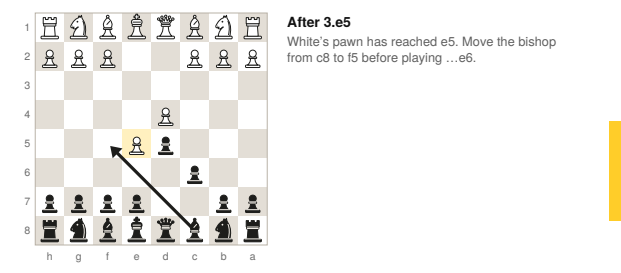
| Field | Text |
|---|---|
| Identify by | White’s e-pawn on e5, next to your pawn on d5. |
| What | The Advance is White pushing the e-pawn to e5, which gains space. |
| So what | The bishop comes out with 3…Bf5, before …e6 can block it. After …e6, your bishop on f8 supports …c5, which attacks White’s pawn on d4. |
Field marks
Section titled “Field marks”| Field | Short answer |
|---|---|
| White plays | 3.e5 |
| You play | 3…Bf5, then …e6 and …c5 |
Confused with: Exchange
Section titled “Confused with: Exchange”The Advance moves White’s e-pawn forward to e5. The Exchange uses that pawn to capture on d5 instead.
03 Exchange
Section titled “03 Exchange”
| Field | Text |
|---|---|
| Identify by | White’s e-pawn gone and your c-pawn on d5. |
| What | The Exchange is White swapping pawns with 3.exd5. Take back with 3…cxd5. |
| So what | Taking with the c-pawn frees c6 for your knight. If White plays 4.Bd3 to stop …Bf5, put the light bishop on g4 instead. |
Field marks
Section titled “Field marks”| Field | Short answer |
|---|---|
| White plays | 3.exd5 |
| You play | 3…cxd5, then …Nc6 and …Nf6 |
Confused with: The Panov Attack
Section titled “Confused with: The Panov Attack”The Exchange goes on quietly with 4.Bd3. The Panov Attack starts with 4.c4 instead, and White’s c-pawn then attacks your pawn on d5.
04 Main line
Section titled “04 Main line”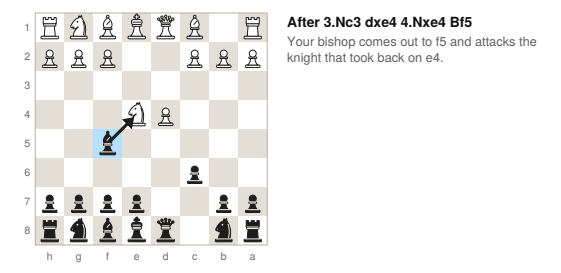
| Field | Text |
|---|---|
| Identify by | White’s knight on e4 after the pawns are exchanged. |
| What | The Main line is White defending e4 with a knight. After 3.Nc3 dxe4 4.Nxe4, play 4…Bf5. |
| So what | The bishop comes out and attacks the knight. After 5.Ng3 Bg6, White often pushes h4. Answer with …h6, so the bishop can drop back to h7. |
Field marks
Section titled “Field marks”| Field | Short answer |
|---|---|
| White plays | 3.Nc3 or 3.Nd2 |
| You play | 3…dxe4, then 4…Bf5 |
Confused with: 3.Nd2
Section titled “Confused with: 3.Nd2”Both 3.Nc3 and 3.Nd2 defend e4. After 3…dxe4 4.Nxe4 they usually reach the same position.
Which traps should you avoid?
Section titled “Which traps should you avoid?”Three traps catch a natural-looking move.
| Trap | Avoid it |
|---|---|
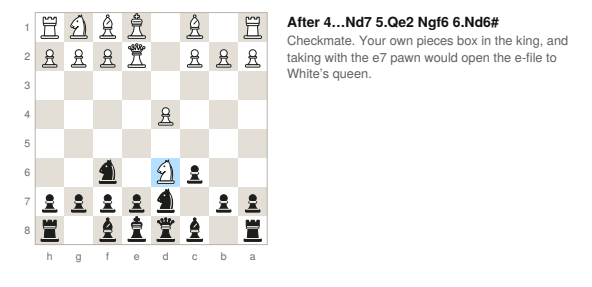
| 5.Qe2 and 6.Nd6 | If you play 4…Nd7 instead of 4…Bf5, meet 5.Qe2 with 5…Ndf6. After 5…Ngf6, 6.Nd6 is checkmate. |
| h4 and h5 | In the Main line, play …h6 when White plays h4 against your bishop on g6. The bishop can then retreat to h7. |
| h4 and g4 | In the Advance, answer 4.h4 with 4…h5. After 4…e6, White traps the bishop with 5.g4 Be4 6.f3 Bg6 7.h5. |
Sources
Section titled “Sources”These public sources were checked on 22 October 2026.
| Source | Date | Address |
|---|---|---|
| Wikipedia, Caro–Kann Defence | October 2026 | en.wikipedia.org/wiki/Caro–Kann_Defence |
| Chess.com, Caro-Kann Defense | October 2026 | chess.com/openings/caro-kann-defense |
| Wikibooks, Chess Opening Theory: 1.e4 c6 and its pages | October 2026 | en.wikibooks.org/wiki/Chess_Opening_Theory/1._e4/1…c6 |
| Wikipedia, French Defence | October 2026 | en.wikipedia.org/wiki/French_Defence |
| Wikipedia, Smothered mate | October 2026 | en.wikipedia.org/wiki/Smothered_mate |
| Wikipedia, Closed Game | October 2026 | en.wikipedia.org/wiki/Closed_Game |
A person writes and reviews every guide. AI does the grunt work.