Getting Out of Trouble in Chess
Draft · Version 0.3.0 · 8 pages · PDF · Word
What are the five problems?
Section titled “What are the five problems?”Five problems turn up often in casual games. Each has a usual way out, and a habit that helps you avoid it next time.
Moves are written in algebraic notation, explained in An Accidental Guide to: The First Move in Chess. In 4…Bd7, the dots mark a move by Black. An x marks a capture and + marks check. Each board is drawn from the side in trouble.
| Term | Meaning |
|---|---|
| Pin | A piece can’t move safely because a more valuable one is behind it. |
| Fork | One piece attacks two or more pieces at once. |
| Back-rank mate | A rook or queen mates a king shut in behind its own pawns. |
| Hanging piece | An unprotected piece is open to capture. |
| King in the center | A king that hasn’t castled when lines toward it open. |
01 Pin
Section titled “01 Pin”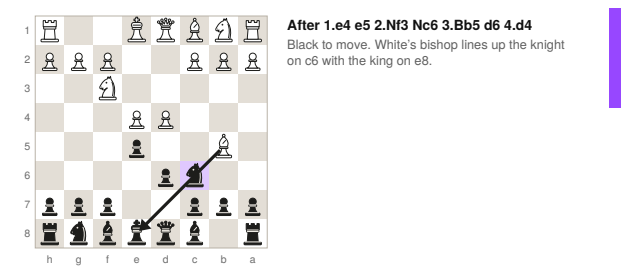
| Field | Text |
|---|---|
| Identify by | A bishop, rook or queen lined up through your piece to a more valuable one. |
| What | A pin means a piece can’t move without exposing a more valuable piece behind it. The knight on c6 is pinned to the king, so it can’t move at all. |
| So what | Block the line with 4…Bd7. Other ways out are moving the king, or capturing or chasing the pinning piece. |
Field marks
Section titled “Field marks”| Field | Short answer |
|---|---|
| Way out | Block the line |
| Next time | Check what is lined up |
Confused with: Relative pin
Section titled “Confused with: Relative pin”With the king behind, the pin is absolute. In a relative pin, the pinned piece may move, but the piece behind it can then be captured.
02 Fork
Section titled “02 Fork”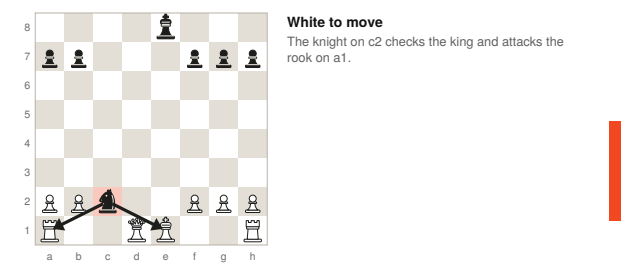
| Field | Text |
|---|---|
| Identify by | One piece, often a knight, attacking two or more of yours. |
| What | A fork is one piece attacking two or more pieces at once. Knights fork well because no piece a knight attacks can capture it, except another knight. |
| So what | Capture the forking piece if you can, here with Qxc2. If you can’t, answer the check and expect to lose the rook. |
Field marks
Section titled “Field marks”| Field | Short answer |
|---|---|
| Way out | Capture the forking piece |
| Next time | Watch enemy knight jumps |
Confused with: Pin
Section titled “Confused with: Pin”A fork attacks two or more pieces at once. A pin stops one piece from moving safely.
03 Back-rank mate
Section titled “03 Back-rank mate”
| Field | Text |
|---|---|
| Identify by | Your king behind its own pawns, with an enemy rook or queen able to reach its rank. |
| What | A back-rank mate is checkmate by a rook or queen along the back rank, the row where the king started. The king’s own pawns block its escape. |
| So what | Make an escape square with h3, so the king can step to h2, or keep a rook or queen guarding the back rank. |
Field marks
Section titled “Field marks”| Field | Short answer |
|---|---|
| Way out | Give the king a square |
| Next time | Guard the back rank |
Confused with: A safe castled king
Section titled “Confused with: A safe castled king”Castling usually makes your king safer. The pawns that shelter it can also trap it on the back rank.
04 Hanging piece
Section titled “04 Hanging piece”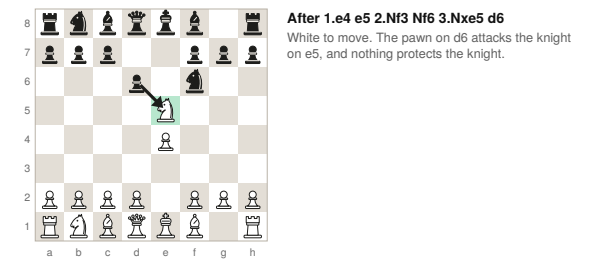
| Field | Text |
|---|---|
| Identify by | A piece that nothing defends, with an enemy piece attacking it. |
| What | A hanging piece is unprotected and can be captured, like the knight on e5. |
| So what | Move the piece to a safe square or defend it. Here, move the knight back with 4.Nf3, because a pawn attacks it. |
Field marks
Section titled “Field marks”| Field | Short answer |
|---|---|
| Way out | Move it or defend it |
| Next time | Check what is unprotected |
Confused with: En prise
Section titled “Confused with: En prise”En prise covers any piece that can be taken at a loss, including one with too few defenders or one attacked by a cheaper piece.
05 King in the center
Section titled “05 King in the center”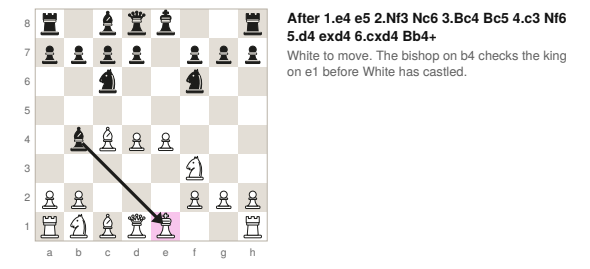
| Field | Text |
|---|---|
| Identify by | Your king still on e1 or e8, with open lines toward it. |
| What | A king in the center is a king that hasn’t castled when lines toward it open. With the c-pawn and d-pawn gone, the bishop on b4 reaches e1. |
| So what | Block the check with 7.Bd2 or 7.Nc3, bringing a piece into play, then castle. |
Field marks
Section titled “Field marks”| Field | Short answer |
|---|---|
| Way out | Block, then castle |
| Next time | Castle early |
Confused with: Castling out of check
Section titled “Confused with: Castling out of check”You can’t castle while in check, or across or onto a square an enemy piece attacks.
Sources
Section titled “Sources”These public sources were checked on 22 October 2026.
| Source | Date | Address |
|---|---|---|
| Wikipedia, Pin (chess) | May 2026 | en.wikipedia.org/wiki/Pin_(chess) |
| Wikipedia, Fork (chess) | July 2026 | en.wikipedia.org/wiki/Fork_(chess) |
| Wikipedia, Back-rank checkmate | May 2026 | en.wikipedia.org/wiki/Back-rank_checkmate |
| Wikipedia, Glossary of chess | October 2026 | en.wikipedia.org/wiki/Glossary_of_chess |
| Wikipedia, Giuoco Piano | September 2026 | en.wikipedia.org/wiki/Giuoco_Piano |
| Wikipedia, Ruy Lopez | October 2026 | en.wikipedia.org/wiki/Ruy_Lopez |
| Wikipedia, Petrov’s Defence | October 2026 | en.wikipedia.org/wiki/Petrov%27s_Defence |
| Chess.com, Chess Terms: Pin, Fork, Back-Rank Mate, Hanging Piece, Check, Castling | October 2026 | chess.com/terms |
A person writes and reviews every guide. AI does the grunt work.